
Opening
Singapore is one of the world's busiest port cities and one of the most competitive ship chandling markets. The Port of Singapore handles over 130,000 vessel arrivals annually, and the chandling community serving those vessels is dense, experienced, and operates on thin margins. In this environment, pricing differentiation is limited, reputable chandlers at a major hub like Singapore are competitive on cost. The differentiator that determines who wins business is speed-to-quote.
A mid-size Singapore chandler with 18 years of operation and a strong reputation among tanker and bulk carrier operators was experiencing a problem that reputation alone could not solve. Their RFQ response time had crept up to an average of 36 hours as RFQ volumes increased during the post-Red Sea rerouting period. Fleet operators were confirming with competitors before their quotes arrived. The company was not losing on price. It was losing on process.
Why It Matters
The ship chandling market serves over 50,000 port calls per year globally. A vessel arriving at a major port has a limited window, often 18-48 hours, during which provisioning must be confirmed, sourced, and delivered. Fleet operators send RFQs to three to five chandlers simultaneously and commit to whichever responds first with a complete, accurate quote.
A 36-hour average response time is commercially problematic in this environment. Most decision timelines in active port calls are under 12 hours. A chandler who consistently finishes second is paying the relationship cost of maintaining the client contact without receiving the orders. The frustration among the company's sales team was real: they were quoting accurately and losing anyway.
The root cause was not personnel quality, the quoting team was experienced and accurate. The root cause was manual processing throughput. At 50-120 line items per RFQ, manual pricing across the catalogue, stock checking, and quote document preparation consumed 2-4 hours per RFQ. During peak periods when multiple RFQs arrived simultaneously, the queue extended beyond 24 hours before the first quotes left the building.
The Challenge
Three operational bottlenecks drove the response time problem:
1. Inconsistent RFQ formats. Fleet operators sent requisitions in every conceivable format: structured Excel with IMPA codes, free-text Word documents, PDF attachments with handwritten annotations, even WhatsApp messages with photo lists. Each format required different interpretation before any pricing could begin. A team member spent 30-45 minutes on format interpretation before touching the actual quoting work.
2. Manual catalogue matching. The chandler's product catalogue contained approximately 8,000 items. Matching an incoming RFQ's descriptions to the correct catalogue entry, especially for free-text descriptions that used non-standard terminology, required experienced knowledge. Junior staff made matching errors that required senior review, adding time to every RFQ cycle.
3. Sequential processing. RFQs were processed one at a time by a team of five quoters. A queue of five simultaneous RFQs did not take five times the processing time of one, it took more, because coordination overhead increased as the queue grew and priorities had to be managed manually.
The Solution
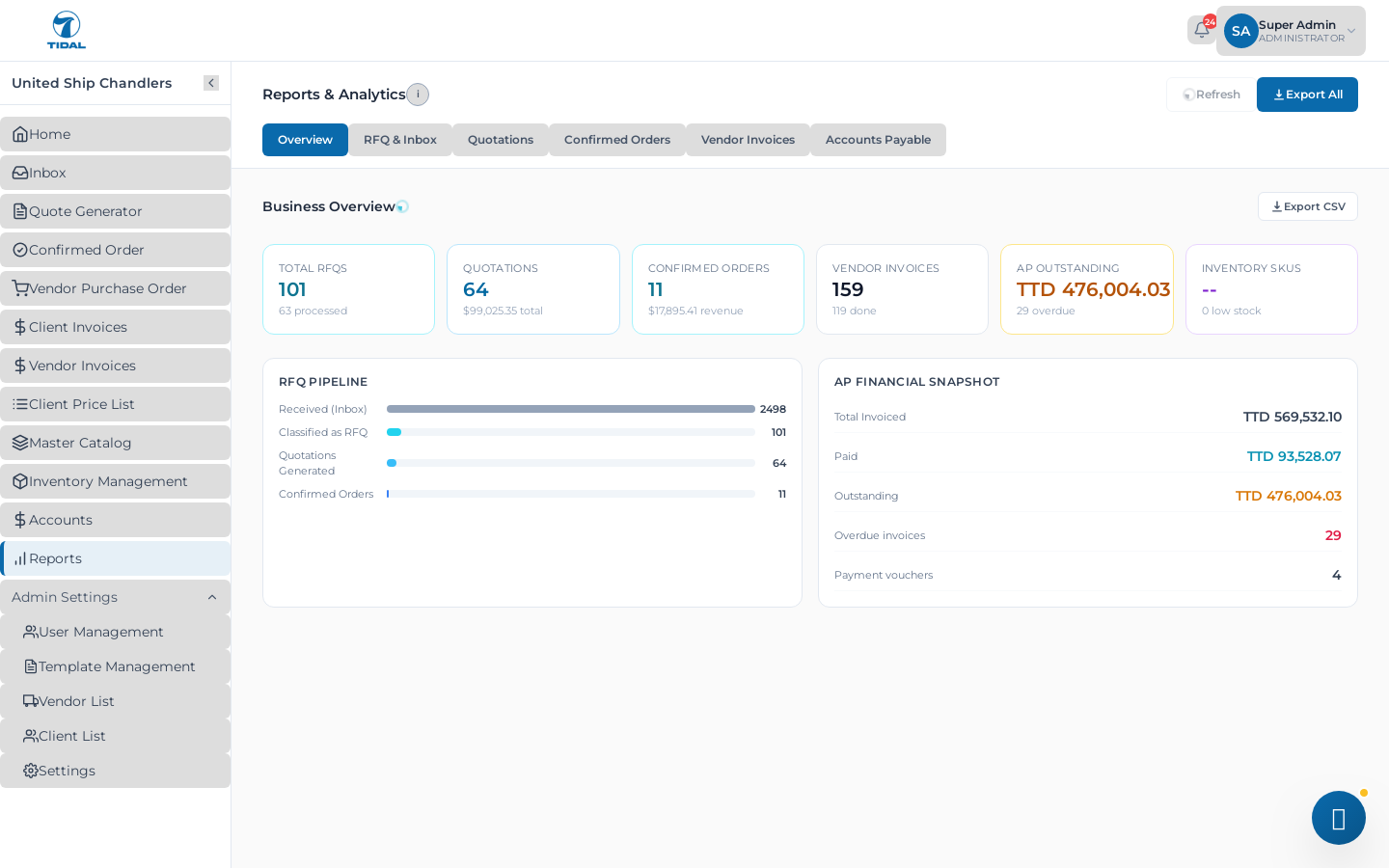
Tidal's ship chandler software automated the three stages where time was lost. Incoming RFQs, in any format, are parsed by Tidal's intake engine: IMPA codes matched directly to the catalogue, free-text descriptions matched through AI-assisted product recognition trained on maritime supply terminology, and ambiguous items flagged for human review with the closest catalogue alternatives pre-populated.
Stock availability is checked against the chandler's inventory in real time as the RFQ is processed, rather than as a separate step during manual quoting. Items available from stock are priced automatically using the configured price list and margin rules. Out-of-stock items generate substitution recommendations with pre-populated alternatives for the quoter to review.
The quoter receives a pre-populated draft quote: all available items priced, substitutions flagged, unavailable items marked, and the quote formatted in the structure the fleet operator expects. The quoter reviews, approves, adjusts any items requiring human judgment, and sends. The review step takes 15-25 minutes. The previous total process took 2-4 hours.
Under the Hood
Tidal connects to the chandler's existing inventory management system via API, pulling real-time stock levels and updating as items are allocated to quotes and confirmed orders. The product catalogue in Tidal includes both IMPA code mappings and AI-trained synonym matching for non-standard terminology, the system learns from corrections made by the quoting team over time, improving accuracy as it processes more of the chandler's specific catalogue.
RFQ intake supports email parsing (the chandler's existing RFQ inbox is monitored by Tidal, with incoming emails parsed and converted to structured requisitions automatically), direct Tidal platform submission from fleet operators who are also on the platform, and manual upload for edge-case formats.
Quote output is generated in a configurable template that matches the chandler's existing quote format, the fleet operator receives a document that looks identical to previous quotes, just faster.
Results
Results measured over 90 days post-implementation:
| Metric | Before Tidal | After 90 Days |
|---|---|---|
| Average RFQ response time | 36 hours | 2.8 hours |
| RFQs handled per week (peak) | 22 | 31 (40% increase) |
| Quote accuracy rate (no post-send corrections) | 88% | 96% |
| First-to-respond rate (vs. competitors) | ~35% | ~78% |
| Wins from RFQs responded to first | Data not previously tracked | 71% of first-response quotes won |
| Headcount change | , | 0 additions |
The win rate data was the most significant finding. The company had assumed that winning business was primarily a function of price competitiveness. The post-Tidal data showed that 71% of RFQs where they were first to respond converted to orders, suggesting that the fleet operator's decision process heavily favoured the first complete, accurate quote received. Being first with a correct quote was worth more than marginal pricing advantage.
What Comes Next
With response time no longer a competitive constraint, the company is pursuing two new directions. First, expanding the geographic scope of vessels they serve, contacting fleet operators who previously used competitors primarily because those competitors were faster, not better. Second, using Tidal's order history and performance data to build a supplier scorecard for their own procurement, identifying which sub-suppliers and wholesalers they source from are most reliable, to reduce the substitution rate that remains their primary source of post-delivery disputes.
Key Takeaways
- In competitive port chandling markets, speed-to-quote is the primary differentiator, price and quality being near-equal across reputable chandlers.
- The response time problem was a throughput problem caused by sequential manual processing, not a capability problem.
- Automating intake parsing, catalogue matching, and draft quote generation cut response time by 92% (36 hours to 2.8 hours) without adding staff.
- The first-response win rate (71%) was significantly higher than the company had assumed, the value of being first was greater than anticipated.
- Processing automation enabled volume growth: 40% more concurrent RFQs handled within the same team size.
FAQ
Q1. How does Tidal handle the variety of RFQ formats that arrive from different fleet operators?
Tidal's intake engine handles IMPA-coded lists, free-text descriptions, Excel attachments, and PDF documents through a combination of structured parsing and AI-assisted product recognition. Items that cannot be matched with sufficient confidence are flagged for human review with closest alternatives pre-populated, rather than silently mismatched or skipped.
Q2. Did fleet operators need to change how they send RFQs?
No. Fleet operators continued to email RFQs as they always had. Tidal's email inbox monitoring converted incoming emails to structured requisitions automatically. For fleet operators who joined Tidal as buyers, direct platform submission was available but not required.
Q3. How did the quoting team adjust to the new workflow?
The primary adjustment was shifting from full quote construction to draft review and approval. Team members with deep product knowledge were redeployed to reviewing the 15-20% of items that required human judgment (unusual items, high-value substitution decisions) while the routine 80-85% was handled by the system.
Tidal cuts your RFQ response time, without adding staff. Request a chandler-side demo and see the quote automation in action. Request Demo →